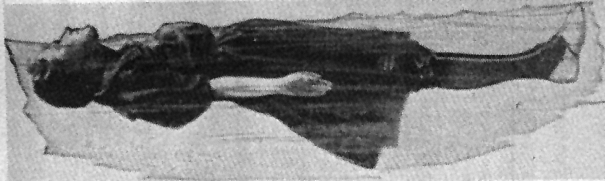
Sleep is a very beautiful thing. So logically constructed. So condescendingly lit. So painlessly painted and so wordlessly written. So gently yet convincingly shaded. So dark, so deep, and so promiscuously real. So ready to receive us like a fresh tourniquet, ready to release us inside itself like a sieve.
Though improperly introduced, we feel inclined to pronounce that we are happy to meet you, these words being sufficiently vague and ill defined to allow the slippage of any specific connotation toward the anterior mean of indifference. However, we stress the words "happy" and "meet," indicating a transcendence of indifference, a veritable indifference to our own indifference which, in any climate possessing degrees and latitudes, approximates adequate signification of a lust for the opposite of the known, the tepid, and the habitual.
Observing our momentary torpor, you remark, as if to no one in particular: "Psyche lusts to be wet, and to die..." and we know then that you see that we speak the language of fragments only, and in fragments only are bound. We are yours completely then, without remainder, but we offer a pitiful pretence at playful resistance with further words. In other words, we unfurl our sails and lean into the warm ripe wind of the flirtatious zones, relying only on the coriolis force to keep us upright in the increasingly rapid whirlpool of delirium which is the world.
"We are more than happy to meet you," we submit, "as we had not formerly realized you possessed such an excellent body." We pause for emphasis. "Is it possible that this body was only recently acquired? Surely this corpus was not purchased locally? Imported perhaps? Assembled in the Philippines or Malaysia?"
"Liberian registration?" we further inquire, "its title traceable only to a highly acronymical offshore geneticlly experimental multinational artificial intelligence biomedical corporate conglomerate, the actual existence of which is entirely open to question? Is this body perhaps stolen?" Your smile seems to widen then, incorporating us into its secret garden of red and blue knowledge. Clutch engaged, we press down on the simple accelerator of our own desire, and advance.
"In any case, now that you have such a good body, and now that we know that you have it, we are very happy to see it. Especially in the light of our most recent darkness, the endless and all-encompassing one we now so gratefully share with you." We make the sign of complete intoxication, submitting totally to the volatile and inflammatory fumes arising from the several glowing apertures of your being. Your eyes are invisible, hidden by lenses of darkeness more absolute than that of the night, but your nostrils flare, as if preparing to inhale us and our verbiage whole. Your undercarriage shifts one degree to the leeward, indicating slight impatience. We panic then, fearing your amply predestined departure, and revert to a more formal and more desperate approach.
"Allow us to extend to you our personal congratulations on your body's imminent ascendance to the throne of mercurochrome, in the meanwhile overlooking the fact that we are grabbing all we can of it, your body that is, in a merely intellectual and symbolic way, and allow us to note in passing that we are stabilized and amplified in a protracted and expanding state of bliss by your continued presence, that is to say, by your temporarily momentous and debilitating inertia. Yes, should the truth be carried aloft by southerly winds, it can be proven that, due to you and the deeply polar nature of your magnetic existence, we are now subjected to a veritable plague of happiness which is, before your eyes, striking us down like veritable flies. We are, in fact, dying of happiness at the mere sight of your transcendental and yet self-illumined torso."
"Who needs chandeliers," we inquire, "when the glaring absence of your eyes is more than enough to ignite every man in the room?"
But we only inquire this to be polite as we have clearly lost your interest, and have exited your gaze by the one-way door at the rear of the well defended city-state which is the source of all your heat and light. Our disappointment is all-consuming and apparently infinite to the naked eye. But our politeness exceeds our disappointment both in quality and in quantity, and all that exceeds our politeness is sleep. Sleep and yet more sleep. Sleep the ambivalent. Sleep the fickle. Sleep the vague. Sleep the illicit. Sleep the undefinable. Sleep the beautiful.
Sleep is a very beautiful thing. So brightly and edgelessly outlined, and yet so seemingly free of artifice. Not to mention so seemingly free of seams. So seamlessly, shamelessly free of even freedom itself. Sleep. Even in its absence we can see that it is free of everything except an indescribably terrible beauty and the resulting voluptuous convulsions with which we are taken in. From behind, as it were, and by surprise, as it is.
Abandoned to our darkness, we gather skeletons in ancient cemeteries. The night is opaque, warm, and very amusing. Many of us aggressively choose a skeleton for our own, holding the bones close and crouching in a defensive posture, as though at a blue light sale. Others of us hold back and allow ourselves to be chosen. Many of us give the skeletons trinkets and speak to the skeletons with the voices of the living. Some of us curse the skeletons, nag, scold and berate them. Many of us insult the skeletons with comments about poor posture and calcium deficiencies, the obvious lack of dental hygiene, and other forms of human abuse. Others of us dress the skeletons in our own clothes, and pose and animate their limbs in a brittle imitation of animate life. Some of us hang our own flesh from the skeletons' empty protrusions, and when we exchange sunglasses and paint on deceitful smiles, the illusion of humanity is complete. Someone, no one now remembers who, or no one will admit to remembering, suggests the game of changing places with the skeletons, just for a while, just for a joke. And no sooner is this desire suggested than it is.
The skeletons rub their naked eyes in disbelief. Some are crying in astonished and bewildered happiness until they look up and see all the laughing skeletons surrounding them, and then they waste no time getting out or there fast. As we begin to realize that our very flesh has been purloined, we enter the ground to try to hide our new and absolute nudity.
For years the skeletons live, losing themselves in the variegated and proliferating mass of human animals, and they ask themselves no difficult questions. They strive to lose their calcified accents and brittle walk. They watch others intently and learn how to exist without thinking as the others do, from the inside out, not looking or speaking, not seeing or doing, just working and consuming the many things they are instructed to consume. Then, in religious school, they are given a choice of essay questions. They are asked to describe the afterworld in twenty-five words or less, or to explain the concept of immortality from the point of view of an unbeliever. They have no trouble writing evasive responses, as all the other students do, but when they are asked to read their words in front of the class, they choke on the answers, each and every one. We are aware this is a bit much. A hard pill to swallow. There are some pills that are not meant to be swallowed. There are some pills one can only taste. Perhaps it is actually before one really tastes it that one slips inside it. Sleep, we mean.
We have met you and made advances. Perhaps improperly so. Perhaps we went too far in presuming a unified field of homogenous sexualized experience between us. To have taken your provocation as invitation to profess our avocation. To have succumbed to passion when cool reason should have quantified the day. Nevertheless we have met you and have made advances and we have had to retreat and reconnoiter, pondering the vast terrain of what might have been.
"Your clothes are gorgeous," we might have said. Or better, perhaps, should we have dared to admit it, it was your lack of clothing. Is it politically incorrect or merely opportunistically optimistic to see a body clad in nothing but a wish and a handshake as semi-nude rather than half-dressed?
But regardless of the terms we choose, it is always the lack which seems so gorgeous and seductive, inviting as it does, a sense of debatable participation. Yes, it is precisely the lack that we like. It is a sparse but stylish commentary stretched weightlessly across the contents of your perfectly bound, yet open torso. In the field of phenomenological speculation opened up by the inverted hermeneutics of your unconscious decolletage, we are required to cover you with our own flimsy need, wrapping it carefully around tender circumferences which defy precise mathematical description, trying always to guess what it is we are missing there, breathlessly, just beneath the surface of our impertinent perceptions. This guessing game is the most powerful aphrodisiac, the most potent anesthetic, in the world.
We have lost you, and must wander now in search of that lack, certain never to find it, or at least, never to find it again.
We say good evening to the terrifying whores that line the pockets of each sidestreet we enter. But we are careful not to tell them that they are beautiful. We do not tell them they are beautiful even if they are beautiful, which only means, in these parts, that they are more expensive. As beauty rises, so does the cost, until it reaches an aesthetic realm beyond the reach of pocket change. Though, as every whore and wage slave can tell you, there is nothing which exists or can be imagined which is out of the reach of folding money. Having taken a vow of poverty, we aim our wallets at the end of the street and avert our pockets from theirs.
Though surrounded by the winking apertures of all creation, we do not tell them how beautiful they are because they know just how much they are and how much it is. We say good evening but we do not even hazard a smile. We aim to please, but we never shoot. We are aware that the smile is a universally misunderstood gesture. We are solitary beings and our condition is terminal. Our nature is entirely artificial and solipsistically mortal and it ends only in the middle, where it slips through the edge of itself and into that other world of voices and eyes. The end we seek terminates only there in the concave solidarity of sleep.
Convinced now that our direction is wrong, we fill out the customary forms and stand in line to apply for a new one. We appeal to the supreme central government of Sleep for a passport and visa. We are told to stand in other lines to obtain other forms. We are assigned seats on an endless bench. We stand in other lines and fill out other forms and enter another room of lines and forms with many others like us waiting in lines for forms. We forget which forms we wait for. We forget which forms to hold in which lines. We forget which way the lines are moving. We forget the difference between line and form. We wait, filling an infinite room to overflowing with identical attitudes of hopeless passive angry pensive indecision. We survive by thinking only of you.
Nothing so shapeless as the night could fill you out in such a perfectly empty way as to convince us so strongly of your formal necessity as you do in your nonlinear informality. And nothing so formless as ourselves reminds us so much of you as you do in your shameless and incessant necessity. We wait, beyond all hope of an end to waiting, knowing full well that in the next room, at the end of this single labyrinthine line of empty forms, on the other side of a monumental marble desk, representing an immense, impossible, immobile over-regulated bureaucracy, is the end we all seek, Sleep itself.
Her heart tore on the sharp corner of the chair as she stood up to go.
"Damn!" she thought. But she made no sound, no sign, and she did not cry.
The interview had been fatally brief, a sure sign her position had already been filled. She would be out on the street in two weeks. But she wouldn't dance or turn tricks. Not again. She'd kill herself first. She thought about taking out a huge insurance policy on herself, making her parents the beneficiaries. Just so they could tell their friends, "Yeah we made a bundle on the kid's death. Wasn't worth a dime alive, but dead she's a gold mine, our little baby-girl!"
She pulled a red brick building up against her back and tried to look, for all the world, like she didn't care, like a woman made of stone. Or maybe brick, or even clay. But not a man-made woman. Not anything like that. Never. No, she wouldn't kill herself. Wouldn't give her folks the satisfaction. Instead she'd wait. She cried then, just a little. But not for anyone else. Just for herself alone. She hated waiting more than anything in the world.
She waited.
But not for him. Not for a man. Never again would she wait for any man.
She waitressed.
She waited.
Waitressed.
Waited.
Waitressed.
And after she'd waited so long she forgot to wait anymore, he came along. He smiled at her sarcasm. He laughed outright at her pessimism. He was charmed by her narcissistic nihilism. She reminded him of Mom. He pursued her, even though her resistance appeared infinite. He slowly and silently saved her from her long-postponed and long-awaited imaginary suicide, bound her hopelessly again to the piercing, permeating, and redundantly pleasurable boredoms of common life. He looked deep into her eyes and didn't scream when she let him see what she had back there. He didn't even flinch. He proposed. She accepted. But he refused to make love to her in the normal way. And never with the lights on. "What's the deal?" she kept thinking. She went back and forth thinking it must be something wrong with her, something wrong with him.
Her.
Him.
Her.
Him.
Then one day it hit her.
"It's that damn run," she thought, "it's showing."
Sleep is a very beautiful thing. So carefully crafted. So craftily shot. So moderately temperatured. So anonymously monitored. So smoothly and potentiometrically rounded at the edges.
Now many other things are beautiful, in addition to and apart from sleep. In certain situations an orange can be beautiful, though generally not as beautiful as a breast painted orange, and certainly not as beautiful as a breast which tastes of orange, as one often encounters in certain regions of Sleep.
The moon appears beautiful at a distance, and beautifully ugly without that distance, which would seem to suggest that in some instances, distances are beautiful. However, a walk taken along that distance is beautiful only in exact proportion to the lack of dogs barking and biting at one's heels as one walks. Poetry, at the very least, should be indescribable and therefore should not be described as being beautiful in precisely the same way that common flatulence is generally considered to be neither beautiful nor desirable, except in certain extreme and desperate situations. Oddly enough, human life, when examined quantitatively, appears to be composed almost entirely of such situations, varying only in degree, and not in kind. But do not be confused by such ambiguities and ambivalences: these are actualities and exactitudes we describe here, though often only from memory.
We realize, more acutely than most, that even our own memories are not to be trusted, as dreams and memories both serve the purposes of other patrons. However, we must reassure you that we are not one of those who fall victim to hallucination at the sight of twelve inch nudes cavorting on the ceiling when strapped to a torture rack made of ivory, rust, and bone. Nor do we distract ourselves with infantile fantasies when electrocuted in private regions for political reasons. No. Well, at least not that often. Certainly no more than is usual. Not that abruptly, anyway. We definitley do not fall prey to delusion and delirium on a daily basis. Well, not all day every day. Well, at least, not without the sensation of falling, or at times the ominous scent of orange flesh.
Sin and sensation, a necessary unity?
Common sense and common sensuality, an equation worth exploring?
Yes: the articulation of sensation:
Around the sensation a body. At the end of the body a head. Under the head, a pillow. Under the pillow a sheet of smooth fibers, woven for sin and for sleep. Under the sheet a mattress, stuffed for softness and sensuous senselessness. Under the mattress a box spring, font of unknowing, all shock absorbing, all amplified motion echoing and ending. Under the box spring a frame. Under the bed frame uncharted space and some dust and an overturned shoe; a black concavity that comes to a point. Under the shoe a floor of tile, under the tile a subfloor of wood. Under the subfloor, pressure treated joists. Under the joists beams, posts, and concrete. Under the concrete an earth. What could be more natural?
To forget. To forget the head. Forget the pillow. To forget the sheet, the mattress, the box spring, the frame. To forget the space, the shoe, the floor, the house, the structure, the concrete, the earth. That could be more natural. That is, in fact, nature's act.
Someone said once: To dream is nature. To forget is merely to reinvent the real.
Or was it the other way around?
I can't remember.
We arrive. Where have we been, she asks us. She is not pleased. We remind her that we have never been completely responsible for who we are, for what we have done, let alone for where we are and even less so for where we have been. We remind her that she too must share in the responsibility for where and what we are and where we have been and how we have been when we were there. After all we commute to work and sit at a desk and despise ourselves completely for her, and not by reason of choice or preference. We remind her that, in fact, as the observer cannot be separated from the observed, she is implicated in the very questionable reality of our physical existence in any given location. We remind her that her point of view is inseparable from, and formative of our relative positions within it, her own presumptions serving as the frame from which a portion of our being is cut and hung.
We are here now, we explain magnanimously, because she is, and because we want to be with her. We were where we were before because she was not and we wished to be without her, then, all the more to appreciate the being with her when we returned. Yes, precisely. We always find that we really have very little choice in these matters. Much less than you'd imagine.
She glowers predictably, and her hatred smolders within her. She's heard these words before, and knows we have been at the Titty Bar just outside of town. It was that beautiful smoldering wrath that first attracted us, when we came across the prairies, crawling through alkali flats, dehydrated and suffering from terminal hypoglycemia as well as numerous vitamin and mineral deficiencies. It called out to us, drew us across the great plains, dragged us across the great divide, dragged us all the way to the edge of the world, then sucked us into the ocean and drowned us all.
She tells us only then that she is expecting, and at first we think it is just a word like any other.
We marry. We learn to lie, to evade, and to worry. We have children. We learn then to laugh, and to worry much harder. The children hound us for years, interrupting our every thought, sucking the words from our minds so that we no longer even have the power to think in sentences. We think and speak only in fragments. Saying Wait a second. But you. What I meant was. What the hell did. What do you think you're. If you ever do that again I'll. Stop that right now. What did I say? Don't. Ever. Hey. Stop. Quit. No. Not now. Thinking, didn't I? Wasn't there a? What did I do with? Can't I just? The mirror becomes an instrument of torture, its cruelty immeasurable. Then suddenly the children no longer speak to us. They can't even see us. They are gone.
The children move away. As far as they can get. We wave from the ruins of what was once a living room. They don't look back. They have gone to college, to jail, to prison and to war. To the mills, the factories, to marry, to make babies and to learn to worry. But we still hear them breathing next to us in sleep. Breathing softly, wheezing like imaginary sponges deep under the ocean's surface. In an absence of real light. In a pressurized depth of precious illusions. We wake, hoping in terror for a heartbeat or a cough.
The children's bodies are beautiful when sleeping, their teeth having been straightened at great cost, their skulls having been stacked neatly in endless rows of bone and shadow, black and white, like keys of a silent piano. A fossil piano just recently unearthed: a sun-bleached mineral piano, one among thousands. And yet it is a hand-cranked streetcorner organ we hear playing toccatas and fugues, filling the hidden chambers of our inner ears with the low and careful colours of morning and loss.
Sick and tired of a steady diet of subtle sarcasms, we become openly caustic. We enter a blue period of unspoken rages. We have become angry and alien, even to ourselves. Drunk with bile, we no longer need even alcohol. We desert Sleep and move in with another woman. The other woman has a fine young body. She thinks we resemble her father. We will fill this body with words and age there, losing ourselves completely, never returning to Sleep.
We cannot just close our eyes to those ancient delusions. We cannot just forget all that has happened. We are men. We have decided. We will escape. We will have nothing to do with sleep. Well, we will perhaps write to her once a month. But we will inscribe nothing personal on the card. We will not even sign it.
We tried to be men. But sleep had our number. She had our number and she kept dialing it. We took the phone off the hook. She sent us a pager. We swallowed it. Sleep counted sheep to us: we countered with wolves. Late at night Sleep threw rain and gravel at our windows and called out to us with a suspiciously delirious and obviously empty metaphor. Sleep clung to our memories with sensations and odors, invading every ventricle of cerebral activity, so that we could barely breathe without calling her name.
Sleep continued to call but we stopped listening, stopped answering. We learned to stop remembering and to stop forgetting.
In the morning we spot an obituary in the paper, supposedly Sleep's. It implies a messy suicide, after a traumatic separation. We are suspicious. Popular factions supporting Sleep's causes may have taken over the press, infiltrating all public media. It is a trap, like so many others she has set for us. We cancel our subscription to reality, duct-taping the door's inbox shut. We pour father's gin into our cornflakes instead of mother's milk. We barricade the doors and windows. We shave our heads and learn again the language of pure hate. We wait and watch the blades of grass on the front lawn as they twist and writhe in the imaginary wind, ourselves and our shotguns loaded.
Provisions run low. We eat the dog, the cat. It is wartime after all, and old friendships mean little. It was them or us, we tell ourselves. When we glance at the new woman, she becomes nervous. She has hidden all the forks.
There have been no calls for a while now. The phone has died and the spirit which animated it is gone. It has begun to rot and stink. A fetid uncertainty gnaws at out doubts. We retreat to the wine cellar to make a last stand, although at this point none of us are capable of standing, exactly. We are convinced now that "death" itself is, and was all along, a trick of sleep's, a trap of sleep's, a disguise. We are certain that soon we will see the face behind that false mask. If there is a face at all. We know that Sleep suffers from a completely symptomless disease of its own manufacture. Turns itself on and off with a hidden switch. Operates on itself with a precise and invisible scalpel. But we never took issue with sleep's self-sufficiency. Our quarrel was always with sleep's totalitarian and imperialist tendencies. We fought for a democracy of sleep, where images would rise from the ranks by popular vote, and retain their shapes by constitutional dictum. But we are forced now to see that our revolution has failed. There is no George Washington of dreams, no Thomas Paine of desire. No Jefferson. No Lincoln. Only Hermes and Medusa and General Anesthetic and the imaginary twin sister that died when we were born. There is only the interminable flood of unstoppable fragments of everything that ever was, and everything that never was as well.
We have come to the horrible realization that the unconscious is an infinite garage sale of the human soul, and that we have been keeping odd bits of stuff since before the beginning of time. Everything stacked and leaning and spilling outward. Everything a symbol of something else.
In absolute horror and despair we must acknowledge the simple truth at the end of the universe: No one's going to buy all this crap.
We have abandoned Sleep for One Hundred and Eighty Days. We claim victory by default. We throw open the doors only to have the whole interior invaded by an absolute darkness which had been outside all along, just waiting. We are completely enveloped, as if in an ocean of dark, and when we open our mouths we breathe darkness instead of air. Our woman has left us long ago , going over to sleep's side, but only now do we notice this as a loss.
Alone again, we drive without direction in our car till dawn, contemplating a nickel's worth of suicide. Coming home drunk, we rampage, but there is no one to rampage to. We make bad black coffee, coffee made from the cheap sun-baked beans of darkness itself, and reconsider. We want to possess sleep and to be possessed. But we cannot surrender. We confess to nothing, as we are certain we have committed no crime. Well, a few crimes, yes. The ones all children commit when they fail to prevent themselves and their desires from existing. The unpardonable sin, the original sin, the concommitant derivative sins, the unspeakable and unmentionable sins and the other common garden varieties of sin. With prohibitions against every pleasure, we are indicted with our first sensation. But we are not guilty of anything more than everything. We will deceive, deny, disseminate, delaminate, decapitate and die rather than to submit to the delirious judgment of Sleep.
Again with the barricades. We take turns standing guard. It is a bad time. Not a lyrical time. Nor a sequential one. Not a time of which the history can ever be writ. A time that passes without tock or tick, like the eternal opening of a tin can with an infinite rim. We know now that infinities are never composed of exactitudes, and we have learned this the hard way. By means of painfully precise and elaborately quantified measurements made in relatively absolute darkness.
We resisted Sleep's advances for One Hundred and Eighty One days. And then Sleep came to us, waving her four white sheets to the wind, but otherwise unarmed. Without pride, without explanation. Demanding no demands, and requesting no requests. But enough of these prosaic descriptors, as they cannot even approach the veritable reality of Sleep's very virtual approach. Mere prose serves only to obscure the fact that our resistance had been worn thinner than nouns. We could see right through our resistance to the pale ugly things we had become. Or perhaps to the things we had been from the beginning, since before the time when the words of the west had won.
We were glad when sleep came to us. After so much of this and so much of that, cause and effect hardly mattered, victor and victim were hardly distinguishable. We were delighted to see our grainy faces fade, forging deep into that forgetfulness from which words arise, and to which they return.
Just one more thing.
I remember only driving in the dead of night down coastal Highway One toward the Jack Tar Hotel, which no longer exists, Sleep soundless beside me all the way. Inscribed carelessly across her aging face were the main sore points of the same endless argument we'd been having since day one. I thought for a moment of the actors who drive in movies, staring always at their lovers or their abductors, staring at the camera really, never even glancing at the road ahead. I tried to imagine what, if I looked only at my companion, we would eventually ram into and which one of us would survive the impact.
I aimed myself at the singular vanishing point ahead, refusing to face anything but the oncoming traffic, sensing nothing but the texture of the pavement rushing always colourlessly beneath us. I was hurt, I'll admit it, so much so that it was painful to breathe. And without love as well, having never discovered any definitive meaning within the empty set of that word. Two separate conditions surrounded and held together by the transparent elegance of the same beautiful lie. It was never my own body that contained me, but hers. I glanced at my companion and realized her face was my roadmap as well as my prison and that the tearworn lines around the closed eyes contained not only every place I'd ever been, but every place at which I could possibly arrive.
I consoled myself then with a nausea specific to winding coastal roads, a convoluted boredom mixed with enough sharp wind and soft fog to call forth, and to camouflage, tears. I ignored the redundant and meaningless words of the insistently monotonous radio voice, and pushed all thoughts of past and future things into the static it contained at its core.
I thought of nothing but the silent coolness of the empty room that awaited me, and the unspeakable emptiness of the cold room I had just escaped.